Newsletter
The GenAI Effect: When Executive Expectations Meet Enterprise Reality
Newsletter header illustrating the gap between GenAI expectations and reality
Just as the popular TV series CSI created unrealistic expectations in courtrooms about forensic evidence, Generative AI is creating a similar phenomenon in boardrooms across enterprises. CxOs today expect AI to deliver transformational results with the same certainty and precision they witness in marketing demonstrations and tech conferences. However, the reality of enterprise AI implementation tells a dramatically different story.
The CSI Parallel: From Courtroom to Boardroom
The "CSI Effect" fundamentally changed how juries evaluate criminal cases. Research shows that 46.3% of jurors now expect to see scientific evidence in every criminal case, with 21.9% specifically expecting DNA evidence. This phenomenon occurred because crime shows portrayed forensic science as infallible and omnipresent, creating unrealistic expectations that influenced real-world decisions.
Similarly, the "GenAI Effect" is reshaping executive expectations about artificial intelligence capabilities. 77% of business leaders believe AI will provide competitive advantage, and 75% expect significant impact on their roles within three years5. Yet, much like the CSI effect in courtrooms, these expectations are often disconnected from implementation realities.
The Reality Gap: Numbers Don't Lie
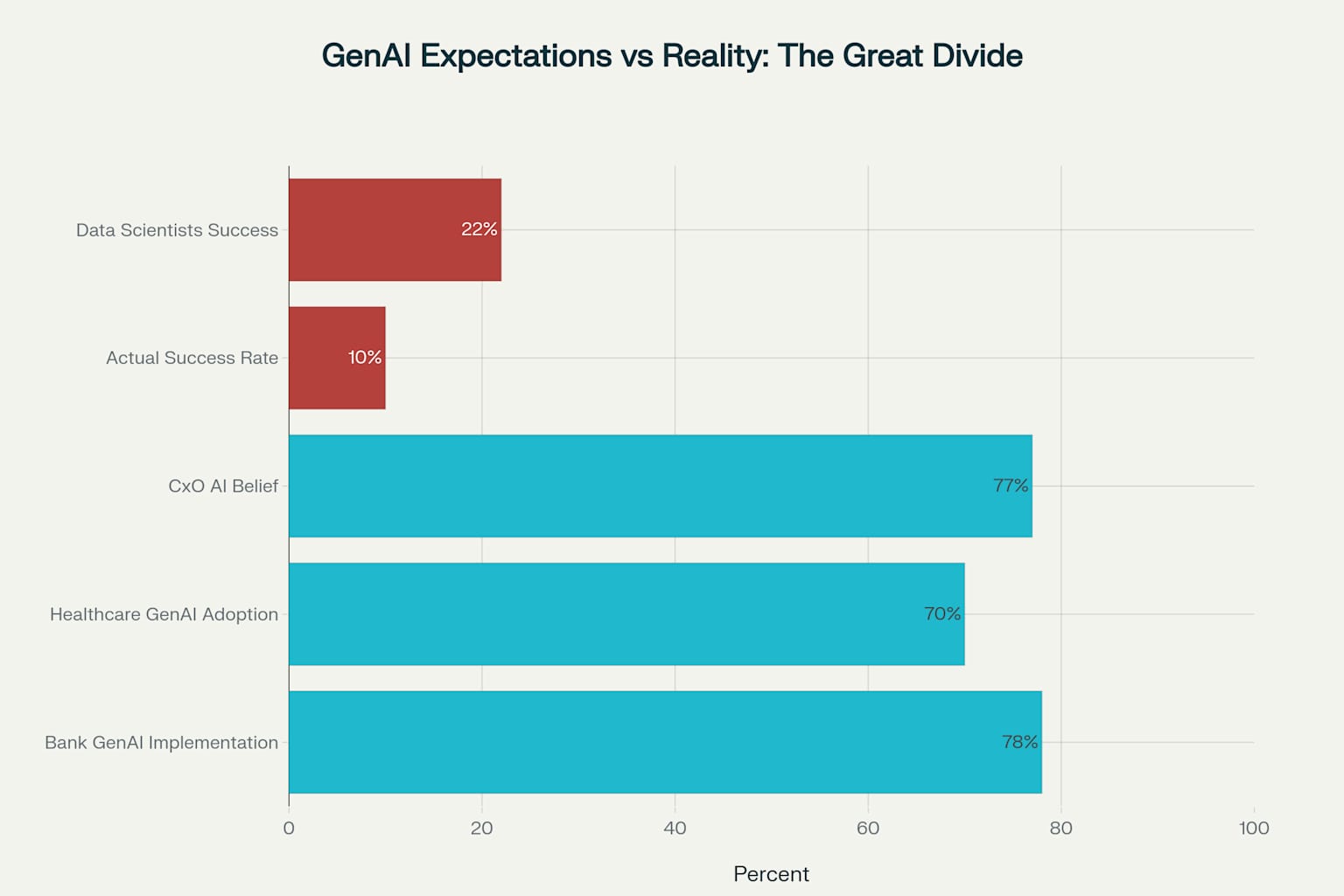
GenAI Expectations vs Reality: The dramatic gap between executive expectations and actual implementation success
The disparity between GenAI expectations and actual results reveals a sobering truth about enterprise transformation. While 78% of banks have implemented generative AI and 70% of healthcare organizations are actively pursuing GenAI solutions, the actual success metrics paint a different picture:
Only 10% of companies report substantial financial benefits from AI investments
69% of operations officers report that technology investments failed to meet anticipated outcomes
51% of US businesses saw no noticeable improvement in performance from digital transformation efforts
Just 22% of data scientists report successful deployment of new AI initiatives
These statistics mirror the CSI effect's impact on jury decisions, where higher acquittal rates occur when expected forensic evidence is absent, regardless of other compelling evidence.
The Expectation-Reality Transformation Flow
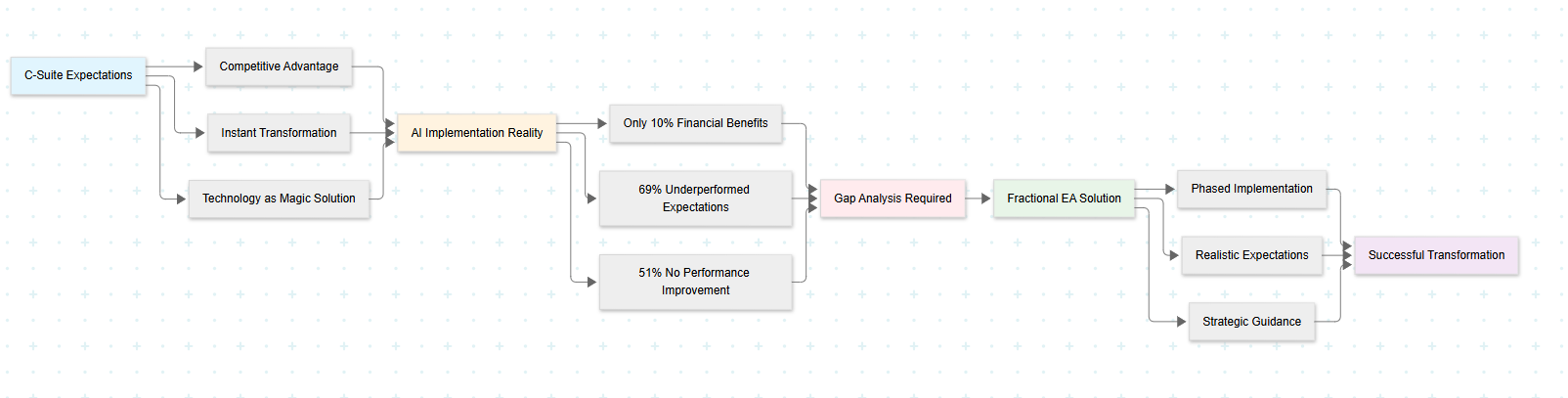
The Role of Fractional Enterprise Architects in Managing Expectations
The rise of Fractional Enterprise Architects (FEAs) represents a strategic response to the GenAI expectations gap. Unlike traditional permanent EA roles, FEAs provide "CIO-level thinking for your EA practice, fractional in cost, but full in impact". They serve as reality-checkers who can:
Bridge Strategy and Implementation: FEAs help organizations understand that successful transformation requires decades rather than years, as historical precedents from Industrial and Digital Revolutions demonstrate. They prevent the over-reliance on technology without proper institutional changes.
Provide Unbiased Perspective: As external experts, FEAs are "not mired in internal politics" and offer "independent, cross-industry insight and fresh approaches to old problems". This objectivity is crucial when managing inflated AI expectations.
Scale with Organizational Needs: Whether organizations need "2 days a month to support governance" or full transformation guidance, FEAs provide flexible expertise without long-term overhead.
Healthcare and Finance: Sector-Specific GenAI Realities
Healthcare Transformation
Healthcare organizations show significant GenAI adoption, with over 70% actively pursuing or implementing solutions. However, success depends heavily on addressing data privacy, regulatory compliance, and system integration challenges. GenAI's impact includes:
Clinical productivity improvements through automated documentation and data extraction
Enhanced patient engagement via personalized communication systems
Streamlined administrative operations reducing manual errors
Financial Services Evolution
The banking sector demonstrates the most dramatic adoption shift, with GenAI implementation rising from 8% to 78% in just one year. Key applications include:
Fraud detection and risk management through pattern analysis
Personalized customer experiences via AI-driven recommendations
Operational efficiency through automated regulatory reporting and code development
Managing the GenAI Effect: Lessons from Enterprise Architecture
Realistic Expectation Setting: Just as prosecutors had to adapt their strategies to account for CSI-influenced juries, CIOs must "manage expectations and avoid over-reliance" on AI capabilities. Enterprise Architects play a crucial role in "turning business strategy into reality" by understanding transformation drivers and aligning changes with strategic goals.
Phased Implementation Approach: Research indicates that "institutional changes are slow and iterative, taking time to fully align with faster-moving technological advancements". Successful organizations recognize that "the best companies in the world are those in a continuous state of transformation".
Data Strategy Foundation: "AI algorithms are not natively intelligent. They learn inductively by analyzing data". Organizations with robust data strategies and analytics expertise significantly outperform those lacking these foundations.
The Fractional EA Advantage in GenAI Transformation
As organizations navigate the GenAI expectations landscape, Fractional Enterprise Architects emerge as essential strategic assets. They provide:
Cost-Efficient Expertise: Access to "top-tier talent with no long-term overhead" while maintaining the strategic depth necessary for successful AI integration.
Scalable Engagement: Flexibility to "scale with your needs" whether for transformation programs or ongoing governance support.
Strategic Reality Check: Ability to distinguish between AI hype and practical implementation, ensuring investments align with achievable business outcomes.
Conclusion: Beyond the Hype Cycle
The GenAI Effect represents a critical inflection point for enterprise transformation. While 83% of executives believe GenAI investments will increase over the next three years, success requires more than technological enthusiasm. Organizations must learn from the CSI Effect's lessons: expectations shaped by media and marketing often diverge significantly from operational realities.
Fractional Enterprise Architects serve as the bridge between GenAI aspirations and achievable transformation outcomes. They help organizations avoid the trap of "common fusion and misunderstanding between AI being productive" and AI delivering transformational business value.
As we move forward in 2025, the organizations that thrive will be those that embrace realistic AI expectations, strategic implementation approaches, and the flexible expertise that Fractional Enterprise Architects provide. The future belongs not to those who believe in AI magic, but to those who understand how to harness AI's real capabilities within the context of comprehensive enterprise transformation strategies.
- AI
- payments
- enterprise architecture
- digital transformation
Related editions
- Stop Celebrating AI Headcount Savings. You Just Deleted Your 2031 Leadership Team.Eighty percent of companies deploying autonomous AI cut headcount, and Gartner says the returns never arrived. The people did not come back. And the juniors you never hired are the leadership team you will fail to find in 2031.
- One GitHub Issue. And the Agent Can Pay.This month, a single opened issue could hijack every repository running Claude Code’s action. The uncomfortable part isn’t the bug. It’s that 1,578 agent tool-servers can now move money, and the exploit shipped in a tool description.
- The Agentic Settlement Layer Just Forked. The Bridge Is Two Issuers Wide.Europe closed its stablecoin door on 1 July. America opens a different one on 18 July. Your agents will settle through whichever side you didn’t architect for.
Have a similar challenge?
Book a 30-minute call to talk through AI governance, architecture or payments: no pitch, just a senior second opinion.
Book a 30-min call