Newsletter
Transforming Transformation
Why Traditional IT Programs Are No Longer Fit for Purpose, and What to Do Instead
By Paulo Falcão, Enterprise Architect | Fractional EA | Strategic Transformation Advisor
Old ways won’t open new doors.
Yet too many organizations are still clinging to the “mega program” playbook when it comes to transformation, only to end up with cost overruns, shifting targets, and minimal ROI. It’s time to evolve.
The Problem: Traditional Transformation Is Built to Break
The corporate world has long been trained to think of transformation as a project. You start with a grand vision, build a massive plan, and launch a multi-year initiative that promises to “change everything.”
But in 2025, that model collapses under its own weight. Why?
Markets shift faster than plans can adapt
Tech stacks evolve quarterly, not annually
People demand results, not 1000-day roadmaps
Transformation fatigue is real
These programs often start strong and stall quietly, caught between legacy infrastructure, misaligned incentives, and the ever-changing business climate.
The Solution: Treat Transformation Like a Platform, Not a Project
Modern enterprises are flipping the script. Transformation is no longer an event; it’s a continuous capability that evolves with the business.
Here’s the shift in thinking:
| Traditional Program | Modern Transformation-as-a-Platform |
|---|---|
| One-time, top-down initiative | Ongoing, modular, capability-led evolution |
| Big-bang delivery milestones | Incremental value releases aligned to outcomes |
| Architecture as documentation | Architecture as execution engine |
| Heavy governance | Lightweight, adaptive governance |
| PMO-owned | Co-owned by EA, business, and product teams |
EA's New Role: Architecting the Transformation Itself
This shift doesn’t mean abandoning structure; it means changing who leads it. Enterprise Architects are uniquely positioned to:
Design modular capability roadmaps
Align outcomes with business value, not just IT outputs
Enable incremental decision-making with architecture as a compass
Steer cultural and operational change-readiness
In short, transformation needs an architect, not just a project manager.
A New Mental Model: Platform Thinking
You don’t launch Gmail or Netflix and say “It’s done.” You evolve it. The same applies to your enterprise.
Your transformation platform should:
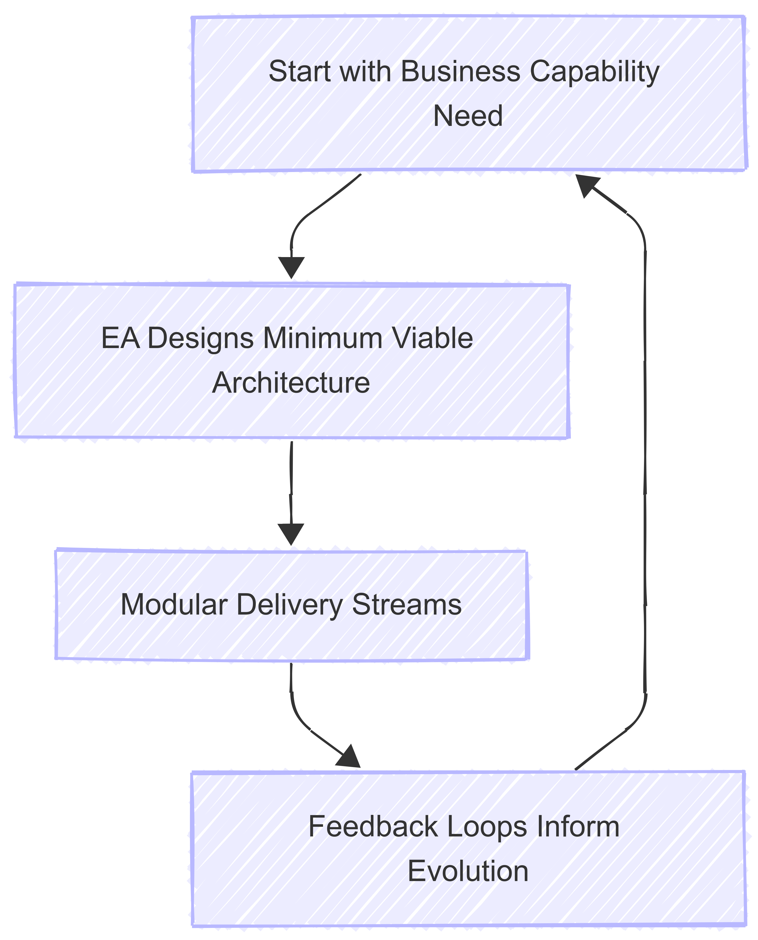
Accept new business requirements and market shifts as inputs
Respond with fast iterations and clear feedback loops
Run continuously, with EA at the helm of change governance
Visual Framework
Real-World Tips to Escape the Program Trap
✅ Prioritize by Capability, Not Department
Focus on what the business needs to do better, not who owns what.
✅ Use Digital Twins
Simulate architectural impacts before you commit. You wouldn’t build a bridge without modeling the stress points.
✅ Balance Agility and Governance
Architect your operating model, not just your systems. Lightweight governance frameworks like adaptive guardrails beat rigid checkpoints.
✅ Celebrate Iterative Wins
Show visible progress often. Transformation credibility is built in weeks, not years.
Why This Matters Now
AI, regulation, climate risk, and customer expectations are evolving simultaneously. Organizations that can’t pivot fast will fall behind.
That’s why modern transformation is not just a tech evolution; it’s an enterprise muscle that must be architected, flexed, and refined constantly.
If your change model still looks like a monolith, it’s not just your systems that need refactoring; it’s your mindset.
Bonus Insight: Where a Fractional Enterprise Architect Adds Value
Not every business is ready for a full-time transformation office or architecture team. That’s where a Fractional EA can:
Rapidly assess transformation health
Design modular execution models
Align roadmaps to business OKRs
Lead change from strategy to systems, without full-time overhead
📌 Paulo Falcão is a 24-year Enterprise Architect and Strategic Advisor specializing in complex transformations in banking, healthcare, and beyond. He advocates for scalable innovation through fractional EA and AI-led frameworks.
- enterprise architecture
- fractional leadership
- strategy
Related editions
- Stop Celebrating AI Headcount Savings. You Just Deleted Your 2031 Leadership Team.Eighty percent of companies deploying autonomous AI cut headcount, and Gartner says the returns never arrived. The people did not come back. And the juniors you never hired are the leadership team you will fail to find in 2031.
- One GitHub Issue. And the Agent Can Pay.This month, a single opened issue could hijack every repository running Claude Code’s action. The uncomfortable part isn’t the bug. It’s that 1,578 agent tool-servers can now move money, and the exploit shipped in a tool description.
- The Agentic Settlement Layer Just Forked. The Bridge Is Two Issuers Wide.Europe closed its stablecoin door on 1 July. America opens a different one on 18 July. Your agents will settle through whichever side you didn’t architect for.
Have a similar challenge?
Book a 30-minute call to talk through AI governance, architecture or payments: no pitch, just a senior second opinion.
Book a 30-min call