Newsletter
When the Builders Break: What the Collapse of Builder.ai Teaches Us About AI Vendor Risk
Date: May 31, 2025
By: Paulo Falcão – Fractional Enterprise Architect
Feature Article: AI Dependency or AI Fragility?
The collapse of Builder.ai, once a $1B unicorn backed by Microsoft and QIA, serves as a brutal wake-up call: entrusting critical systems to third-party AI vendors without proper governance is a strategic vulnerability.
Over 3 million records were exposed due to an unprotected database. The breach wasn’t just a tech failure, it was a breakdown in architecture, governance, and due diligence.
Enterprise Architects must rethink vendor governance models. When AI becomes business-critical, the risk must be managed at the enterprise level, not left to procurement or DevOps.
How to Spot Red Flags in AI Vendors
| Category | What to Watch For | EA Strategy |
|---|---|---|
| Financial Transparency | Fuzzy growth metrics, no audited revenue | Insist on financial vetting and escrow terms |
| Security Posture | Lack of SOC 2/ISO 27001 certification | Mandate vendor security due diligence |
| Operational Resilience | Single-region deployments, no DR plan | Architect for failover; avoid single-vendor lock-in |
| Ethics & Governance | Poor explainability, no ethics board | Push for AI governance frameworks in contracts |
When AI Becomes a Single Point of Failure
Here's a diagram of how poor AI vendor architecture can create systemic risk:
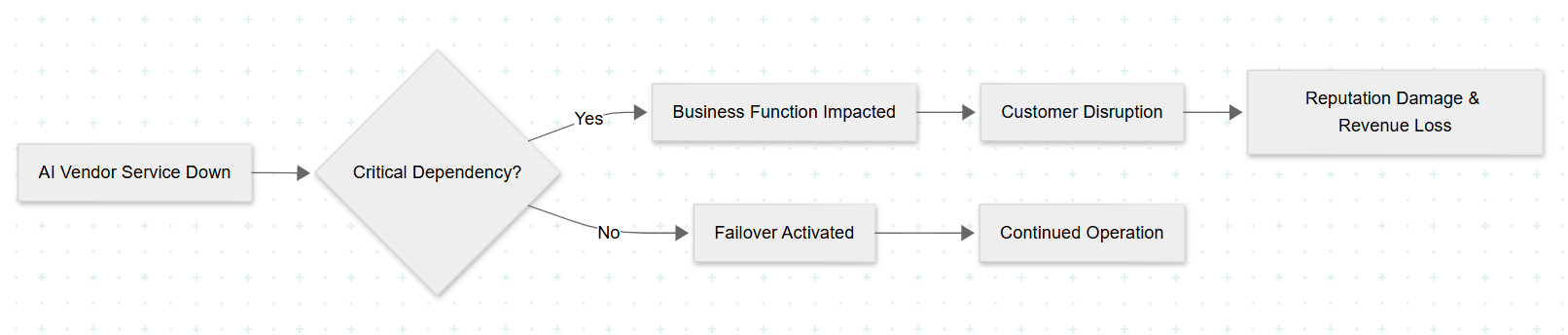
Architect AI integrations with graceful degradation, what happens if the vendor disappears tomorrow?
The Architect's Toolkit: Vendor Risk Defense Playbook
AI Software Escrow: Secure access to source code and models if the vendor fails.
Service Redundancy: Multi-vendor fallback design, especially for LLMs or critical workflows.
Vendor Scorecards: Integrate AI ethics, resiliency, and maturity into your supplier assessments.
Incident Simulation: Test what happens if the vendor goes offline for 48 hours. Are you ready?
Leadership Insight: EA’s Role in AI Governance
Enterprise Architects must act as risk translators, bridging AI enthusiasm and enterprise sustainability. This means:
Designing exit strategies for vendor lock-in.
Advocating for AI governance boards with compliance, legal, and ethics.
Reframing AI contracts to include observability, explainability, and “retrainability” clauses.
Final Word: Build Trust, Not Just AI
As we race to adopt AI, don’t let external tools dictate your internal stability. AI is not magic, it's software, and it needs governance, redundancy, and architectural sanity.
If you’re treating your AI vendor like a magic box, your architecture is already broken.
- AI governance
- AI
- enterprise architecture
- resilience
Related editions
- Stop Celebrating AI Headcount Savings. You Just Deleted Your 2031 Leadership Team.Eighty percent of companies deploying autonomous AI cut headcount, and Gartner says the returns never arrived. The people did not come back. And the juniors you never hired are the leadership team you will fail to find in 2031.
- One GitHub Issue. And the Agent Can Pay.This month, a single opened issue could hijack every repository running Claude Code’s action. The uncomfortable part isn’t the bug. It’s that 1,578 agent tool-servers can now move money, and the exploit shipped in a tool description.
- The Agentic Settlement Layer Just Forked. The Bridge Is Two Issuers Wide.Europe closed its stablecoin door on 1 July. America opens a different one on 18 July. Your agents will settle through whichever side you didn’t architect for.
Have a similar challenge?
Book a 30-minute call to talk through AI governance, architecture or payments: no pitch, just a senior second opinion.
Book a 30-min call